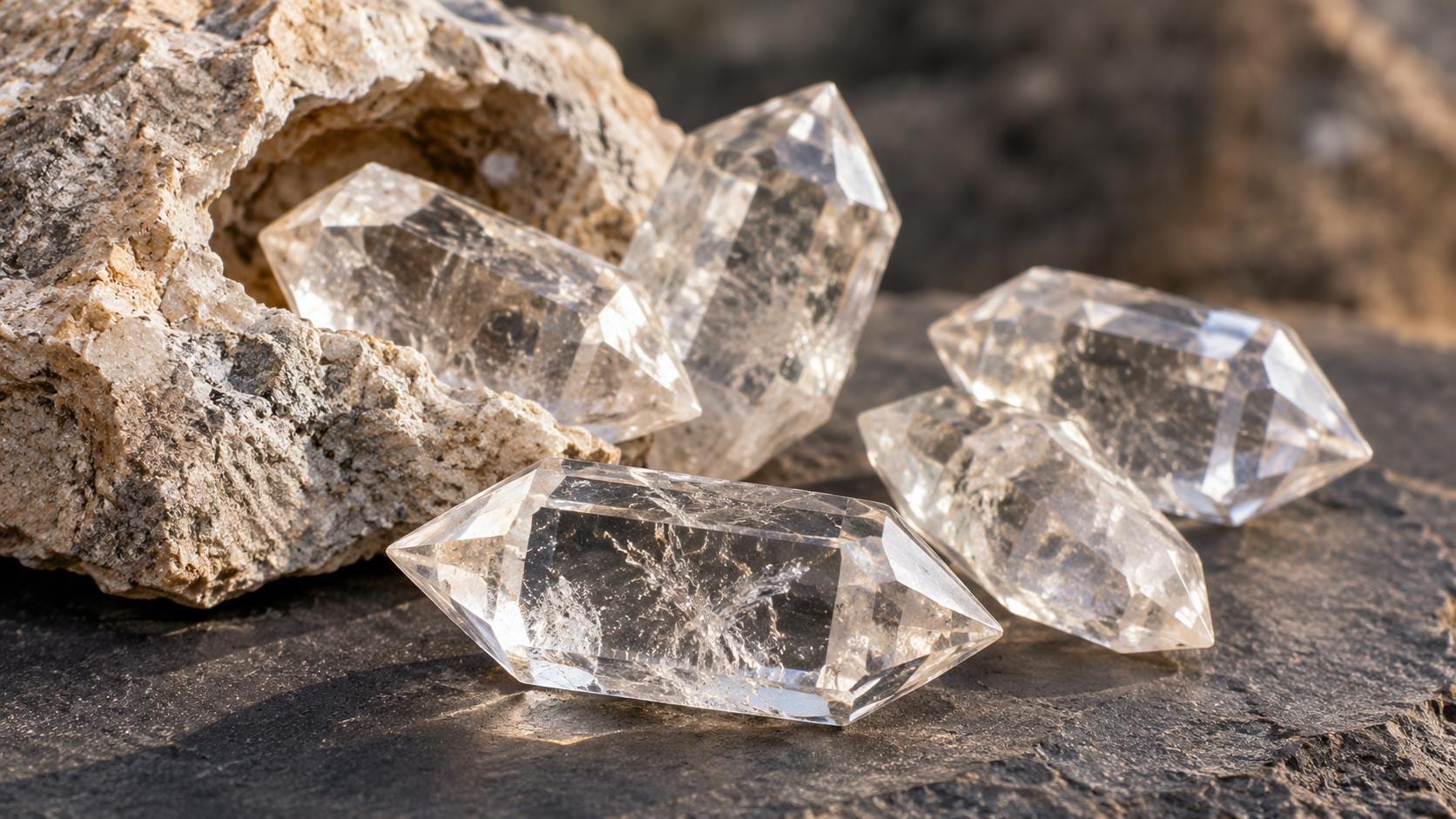
Imagine finding a sparkling crystal inside an ordinary-looking piece of rock. You brush away the dust and discover something extraordinary: a clear, beautifully formed crystal with a point at both ends. It looks polished, almost jewel-like, and practically begs to be held up to the light.
Naturally, someone called it a diamond.
Well, not quite. Herkimer diamonds are actually exceptionally clear quartz crystals, and their natural shape is one of the reasons mineral collectors adore them. They may not be diamonds, but they certainly know how to make an entrance!
So, Why Are They Called Diamonds?
Herkimer diamonds are a special name for naturally occurring, doubly terminated quartz crystals found in and around Herkimer County, New York, particularly in the Mohawk Valley region.
The word doubly terminated simply means the crystal has a naturally developed point, or termination, at both ends. Most familiar quartz crystals have one prominent termination at the top and a base where the crystal attached to its growing surface. Herkimer crystals are different because they developed with little or no attachment to the surrounding rock, allowing both ends to grow freely.
Their exceptional clarity and sparkling natural faces helped earn them the diamond nickname. But their chemistry tells the real story: they are silicon dioxide (SiO₂), the same mineral species as clear quartz, not carbon-based diamond.
Think of them as quartz dressed for a black-tie geological event.
An Ancient Sea Left Behind a Crystal Treasure Chest
The story begins roughly 500 million years ago, when the region that is now central New York was covered by a warm, shallow sea. Sediments accumulated on the seafloor and eventually became the carbonate rock known as the Little Falls Dolostone.
Over immense stretches of geological time, groundwater moved through the buried rock. Chemical reactions and fluid circulation helped create cavities, known as vugs, within the dolostone. Silica-bearing fluids entered these spaces, and quartz crystals gradually grew inside them.
Because the crystals had room to develop without being firmly attached to the cavity walls, some formed points at both ends. The surrounding rock became a natural little nursery for sparkling treasures.
The dolostone is ancient, but the crystal-growth history involves later geological processes. The exact timing and conditions of growth are subjects of geological interpretation, not something we can determine just by looking at a pretty specimen.
Tiny Time Capsules Hiding Inside
Not every Herkimer diamond is perfectly clear. Some contain fascinating internal features that make them even more interesting.
Mineralogists have documented fluid inclusions, solid particles, and carbon-rich material inside these crystals. Some inclusions formed while the quartz was growing; others entered through fractures that later healed. These tiny trapped materials can preserve clues about the fluids and conditions present underground during crystal formation.
A dark speck, a veil, or a tiny internal feature isn't automatically a flaw. It may be part of the crystal's geological history!
Some collectors prize exceptionally clear crystals, while others love the character of inclusions, unusual shapes, or crystals still attached to their original matrix. In the mineral world, perfection is wonderfully subjective.
Are All Double-Pointed Quartz Crystals Herkimers?
Here's an important collecting distinction: not every double-terminated quartz crystal is a true Herkimer diamond.
Similar crystals occur in other parts of the world, including Afghanistan, Norway, Ukraine, and elsewhere. They may have the same general shape and appearance, but the name Herkimer diamond refers specifically to the New York locality.
If you're shopping for one, ask about its origin when locality matters to you. A seller should be able to distinguish a genuine Herkimer locality specimen from a similar-looking double-terminated quartz crystal found somewhere else.
And remember, clear quartz can be cut and polished to imitate the crisp appearance of a natural crystal. Look for natural crystal faces, believable terminations, and reliable sourcing rather than assuming every sparkling double-pointed stone formed in the wild.
A Little History in Every Sparkle
Herkimer diamonds have been known in their home region for a long time. The National Park Service notes that scientific descriptions appeared in publications dating to 1819 and 1823. The crystals later became popular with collectors and helped put this corner of New York on the mineral-hunting map.
Today, the area is famous among rockhounds who enjoy searching through exposed dolostone and discovering crystals tucked inside cavities. There is something wonderfully exciting about the possibility that an ordinary-looking rock may be hiding a natural treasure.
If collecting at a mine, always follow the site's rules and wear appropriate eye protection when breaking rock. Those flying fragments have absolutely no appreciation for your enthusiasm.
Caring for Your Little Geological Diamonds
Quartz has a Mohs hardness of 7, making Herkimer diamonds relatively durable for display and many jewelry uses. However, their pointed ends can chip if dropped or knocked against harder objects. Store them separately from other specimens and clean them gently with a soft brush or cloth.
In modern metaphysical traditions, Herkimer diamonds are often associated with clarity, amplification, spiritual awareness, and energetic balance. These are symbolic beliefs rather than scientifically demonstrated properties, and interpretations vary among traditions and individuals.
Whether you collect them for their natural geometry, their geological history, or their sparkling beauty, Herkimer diamonds are proof that Earth doesn't need a jeweler to create something extraordinary.
Explore more of the fascinating stories behind natural crystals and minerals with Craven Crystals. The next little treasure might be hiding in plain sight, just waiting for someone curious enough to look!