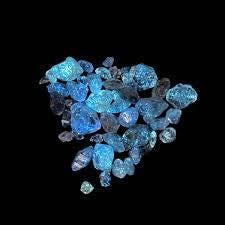
Double-terminated quartz, ancient hydrocarbons, and the unexpected science behind crystals that light up under ultraviolet.
A clear quartz crystal can look like a tiny piece of frozen sunlight. But sometimes, look a little closer and you'll discover something even more unexpected: droplets of ancient petroleum, tiny gas bubbles, and other remnants of the fluids that once moved through the surrounding rock. Switch on an ultraviolet lamp, and those hidden contents may burst into color!
Welcome to the wonderfully strange world of petroleum-bearing quartz, where geology meets a little natural glow-in-the-dark theater.
A crystal with two doors
Double-terminated quartz crystals are fascinating because they have naturally formed crystal points at both ends. Unlike the more familiar quartz points that grow attached to a surface, these crystals can develop freely within open spaces in rock, allowing both ends to form.
Herkimer diamonds are among the best-known examples. Despite the glamorous name, they are quartz rather than actual diamonds, and their distinctive shape is part of what makes them so collectible. Their internal features can be just as interesting as their sparkling points, with inclusions ranging from mineral grains and fluid-filled cavities to dark carbon-rich material.
Petroleum-bearing quartz offers another fascinating chapter in the double-terminated quartz story. Specimens from localities including Pakistan and Afghanistan are known for containing hydrocarbon inclusions, and some display remarkable fluorescence under UV light. Their appearance can be quite similar to other naturally double-terminated quartz varieties, making them an interesting part of the broader quartz family.
One important geological detail: double-terminated describes the crystal's shape, while petroleum-bearing describes something contained within it. Not every double-terminated crystal contains petroleum, and that variety is part of what makes examining natural quartz so enjoyable.
How did petroleum get inside a crystal?
Quartz grows when silica-rich fluids move through cracks, cavities, and other open spaces in rock. As the crystal develops, tiny portions of the surrounding fluid can become trapped inside it. These sealed pockets are called fluid inclusions.
Think of them as microscopic time capsules. Once trapped, the contents can remain enclosed within the crystal for extraordinary lengths of geological time.
In petroleum-bearing quartz, some of those tiny pockets contain liquid hydrocarbons. Depending on the specimen, an inclusion may also contain a gas bubble, water or brine, and dark solid material such as bitumen or asphalt-like substances. Under magnification, these can look like miniature worlds suspended inside the quartz.
Some inclusions are so small that they are difficult to see without magnification. Others appear as little golden-brown wisps, droplets, or irregular shapes within the crystal. A few even contain bubbles that move when the specimen is tilted, provided the inclusion has enough room for the fluid and gas to shift.
It is a remarkable reminder that crystals do not always grow in empty, sterile spaces. They can preserve a snapshot of the complicated chemical environment in which they formed.
Why does the petroleum glow under UV light?
Here comes the showstopper!
Certain petroleum-bearing quartz specimens fluoresce when exposed to ultraviolet light. Fluorescence happens when a material absorbs energy from UV radiation and releases some of that energy as visible light. In petroleum, particular organic compounds, including aromatic hydrocarbons, can produce this response.
The resulting colors vary. Some petroleum inclusions fluoresce blue or blue-white, while others may appear yellow, orange, or another shade depending on their chemical composition and the specimen being examined. The surrounding quartz may remain relatively quiet while the tiny inclusions become the stars of the performance.
In many oil-bearing specimens, it is the hydrocarbon material inside the quartz that produces the fluorescence rather than the quartz itself.
Researchers have studied fluorescent petroleum inclusions in quartz using techniques such as spectroscopy and chemical analysis to identify the compounds responsible. One study of double-terminated quartz from Afghanistan and Pakistan identified alkylbenzenes as characteristic fluorescent compounds in the oil inclusions.
Herkimer diamonds and petroleum-bearing quartz: fascinating relatives
Herkimer diamonds and petroleum-bearing double-terminated quartz share an eye-catching crystal form, but their internal features can tell different geological stories.
Herkimer diamonds from New York are known for a variety of inclusions, including fluid-filled cavities and solid carbon-rich material. Petroleum-bearing quartz from other regions can contain liquid hydrocarbons that produce striking fluorescence under UV light.
A published study comparing double-terminated quartz from Afghanistan and Pakistan with Herkimer diamonds from New York found fluorescent oil inclusions in the former samples, while the Herkimer specimens examined contained solid graphite inclusions.
These findings offer a wonderful example of how crystals with similar shapes can preserve very different snapshots of Earth's history. Locality, mineral composition, and the conditions under which a crystal formed all contribute to its individual character. Whether a specimen catches your eye for its clarity, its inclusions, or its UV response, there is plenty of geology worth exploring.
A little UV safety before the lights go out
If you're exploring fluorescent minerals at home, use a suitable UV lamp and follow the manufacturer's safety instructions. Never stare directly into the light, and use appropriate eye protection. Shortwave UV requires particular care because it can harm eyes and skin. Keep UV lamps away from children and pets, and avoid shining them toward anyone.
Remember, not every quartz specimen will fluoresce. A lack of glow doesn't mean a crystal is fake or damaged. Fluorescence depends on the substances present and their chemical makeup, not simply on whether the crystal is quartz.
The little time capsules inside
Double-terminated quartz already has plenty of personality, but petroleum-bearing specimens add another layer to the story. Within their transparent walls, they can preserve ancient fluids and organic compounds, offering clues about the environments in which they formed.
The next time you examine a clear quartz crystal, take a closer look. That tiny speck might be a mineral inclusion, a bubble, a bit of carbon-rich material, or something that deserves a closer inspection under magnification. And if the specimen happens to glow under UV, you've got an extra reason to be curious!
At Craven Crystals, we love the details that make every natural specimen worth exploring. Sometimes the most extraordinary part of a crystal isn't on the outside at all. It's the ancient little story it has been keeping inside.