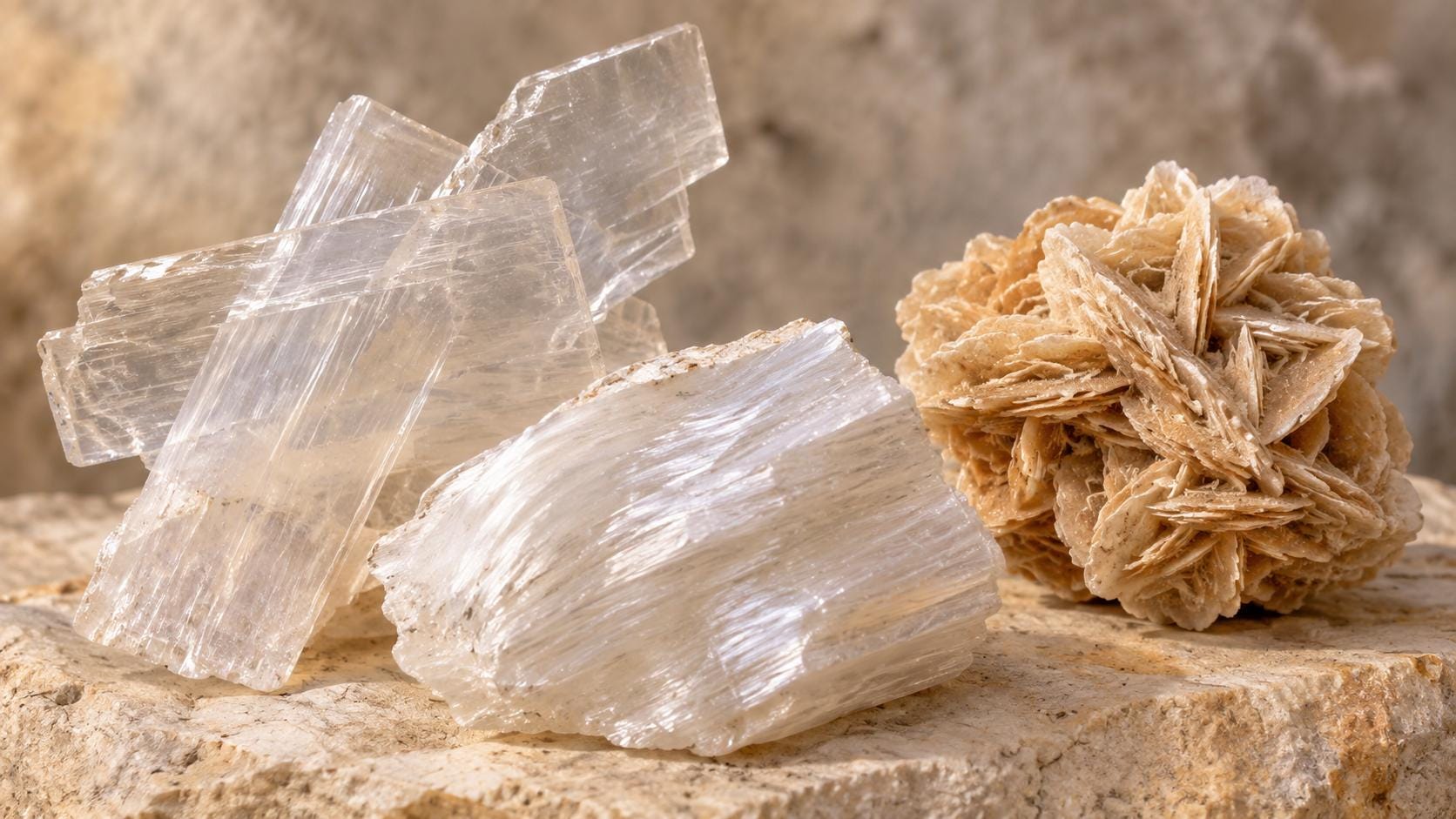
Some crystals sparkle like jewels. Others flash with rainbow colors. And then there's selenite, which looks as though someone managed to catch a little moonlight, give it a crystal structure, and leave it sitting on a shelf. Elegant, dreamy, and wonderfully luminous, selenite has a secret identity: it's part of a much larger mineral family with a fascinating geological story.
And despite its sturdy-looking towers and impressive crystal blades, this beauty is surprisingly delicate. Let's meet the mineral that can build enormous underground wonders but still lose a battle with a fingernail!
Selenite Is Gypsum in Its Crystal-Growing Finery
Selenite is a crystalline variety of gypsum, a mineral composed of hydrated calcium sulfate with the chemical formula CaSO₄·2H₂O. That little bit of chemistry tells us something important: water is actually part of gypsum's crystal structure, not simply something trapped inside it.
Gypsum commonly forms when mineral-rich water evaporates and leaves dissolved calcium sulfate behind. This process, known as evaporation and precipitation, often happens in dry lake beds, enclosed basins, and ancient marine environments. Gypsum is also found in caves and other geological settings where groundwater and surrounding rock create the right chemical conditions.
Its crystal system is monoclinic, and it can grow in transparent blades, broad plates, and other shapes. Some specimens are colorless and glassy, while impurities can produce subtle shades of yellow, tan, pink, gray, and brown.
One Mineral, Several Fabulous Disguises
Gypsum is something of a mineral wardrobe champion. Depending on how it grows, it can look dramatically different while remaining the same mineral species.
- Selenite usually refers to transparent or translucent crystalline gypsum, often found in flat blades or sheets with a glassy or pearly appearance.
- Satin spar is fibrous gypsum. Its closely aligned fibers create a silky sheen that seems to move when the specimen is turned. This is the material commonly shaped into towers, wands, and polished carvings sold under the name selenite.
- Desert roses are rosette-shaped clusters of gypsum crystals that grow while incorporating surrounding sand grains. They look like tiny mineral flowers sculpted by the desert itself. Some desert roses are made of another mineral called barite, so the flower shape alone doesn't guarantee gypsum.
- Alabaster is a fine-grained, massive form of gypsum that has been prized for carving and sculpture.
One mineral, four very different personalities. Nature clearly enjoys a costume change.
The Crystal Cave That Looks Like a Giant's Palace
If you think your selenite tower is impressive, imagine walking into a cavern filled with gypsum crystals longer than a school bus.
Deep beneath Naica, in Chihuahua, Mexico, the famous Cave of Crystals contains enormous transparent gypsum crystals reaching roughly 12 meters (about 39 feet) in length. These giants developed in warm, mineral-rich groundwater under unusually stable conditions over an immense span of time.
Researchers have studied how the crystals grew in water held at temperatures near 54–58°C (129–136°F). The conditions allowed a relatively small number of crystals to grow extraordinarily slowly rather than producing countless smaller ones. Scientists estimate that some of these giant crystals took hundreds of thousands of years to reach their remarkable size.
It's a spectacular reminder that crystal growth isn't always a race. Sometimes the winning strategy is to take your time. A very long time.
A Desert Made From Crystals
Gypsum also performs an unexpected geological trick at White Sands National Park in New Mexico. Its famous white dunes aren't primarily quartz sand, as many people might assume. They're made of gypsum.
Water dissolves gypsum from surrounding mountains and carries it into the Tularosa Basin. As water collects and evaporates, selenite crystals form. Wind, weathering, and repeated collisions gradually break those crystals into smaller grains, eventually creating the brilliant white gypsum sand that builds the dunes.
It's an extraordinary transformation: crystals become sand, and sand becomes a moving desert landscape.
The One Thing Selenite Really Doesn't Like
Here's where this moonlit beauty needs a little special attention. Gypsum is soft, measuring approximately 2 on the Mohs hardness scale. A fingernail can scratch it, and its excellent cleavage means it can split along natural planes of weakness.
It is also slightly soluble in water. That means soaking, repeated washing, and wet cleaning can gradually damage its surface. Keep selenite and satin spar dry, dust them gently with a soft, dry brush, and store them away from harder minerals that could scratch them. Avoid abrasive cleaners and ultrasonic jewelry cleaners.
And please, despite the popularity of water-based crystal cleansing rituals, don't give your selenite a spa day in the sink!
The Symbolism Behind the Glow
In modern metaphysical traditions, selenite is often associated with clarity, peaceful surroundings, spiritual cleansing, and renewal. Its luminous appearance has made it a popular symbol in meditation and crystal rituals. These associations are matters of belief and personal tradition, not scientifically established effects, and they vary among individuals and practices.
Whether you love selenite for its symbolism, its silky glow, or its remarkable mineral structure, there's plenty to appreciate without asking it to perform miracles.
From enormous underground crystal palaces to the white dunes of New Mexico, gypsum has a geological story far bigger than its delicate appearance suggests. The next time you admire a selenite tower or a tiny desert rose, remember that you're looking at a mineral shaped by water, chemistry, time, and a little geological patience.
Keep exploring the wonderful world beneath our feet with Craven Crystals. There are plenty more mineral marvels waiting to reveal their secrets, and we haven't even scratched the surface!