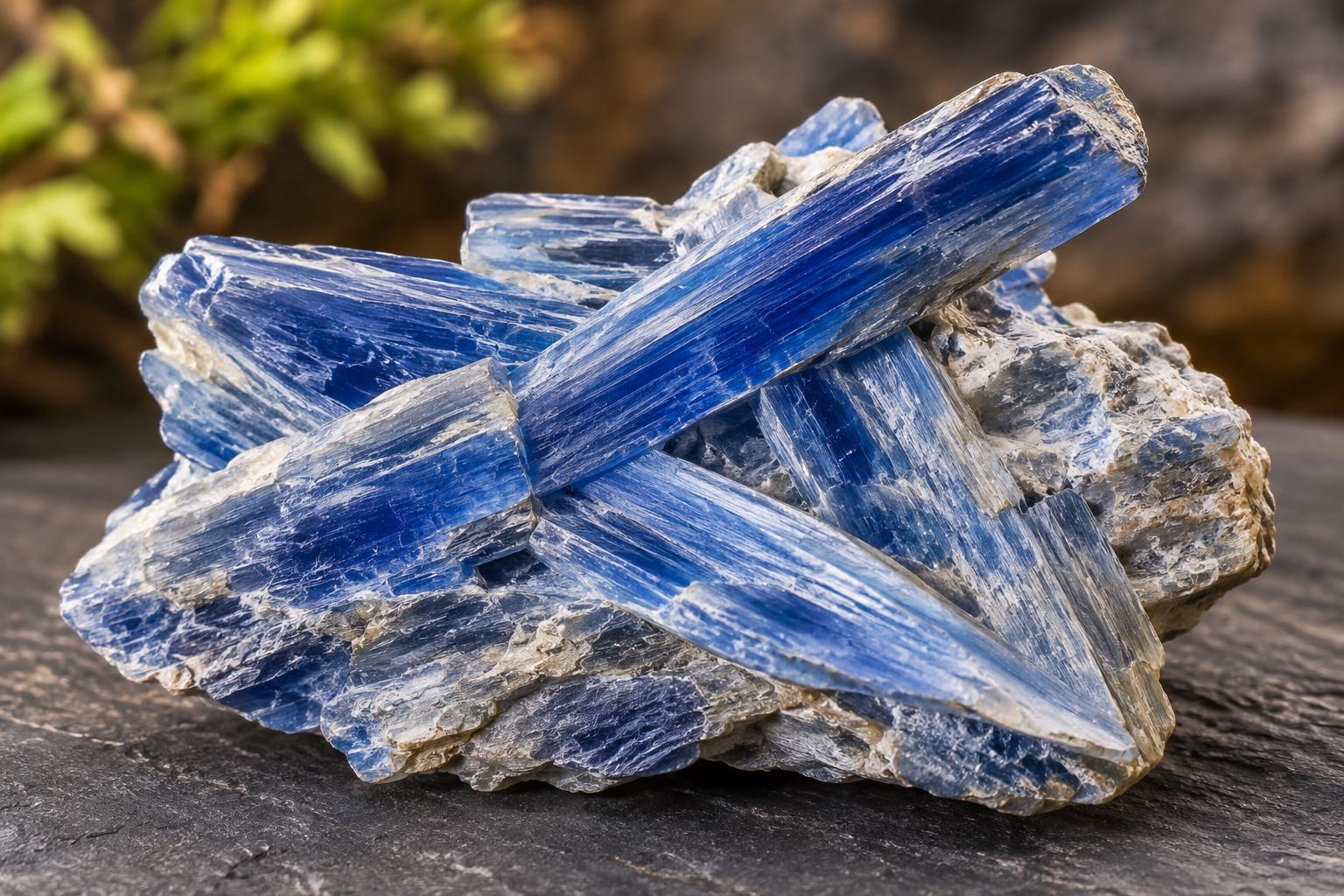
Some minerals have a little personality. Kyanite has a geological plot twist! Its beautiful blue blades can look sturdy and glassy, yet the same crystal may resist scratching in one direction and be much easier to scratch in another. This unusual property makes kyanite a favorite teaching mineral and a fascinating addition to a mineral collection.
What is kyanite?
Kyanite is an aluminum silicate mineral with the chemical formula Al₂SiO₅. It most often appears in shades of blue, from pale sky blue to deep sapphire-like tones, but it can also occur in green, gray, white, and occasionally other colors.
Its crystals commonly grow in long, flattened blades or columns. Their surfaces may show parallel striations, and some specimens have a pearly sheen along cleavage faces. A cluster of blue blades can look like a tiny frozen waterfall or a bundle of mineral ribbons.
Kyanite is most often found in metamorphic rocks, especially schists and gneisses, where heat and pressure transform existing rocks and minerals. Its presence can help geologists interpret the conditions a rock experienced during metamorphism.
The mineral with two strengths
Kyanite's most famous feature is its directional hardness, also called anisotropic hardness. Hardness measures resistance to scratching, and kyanite's resistance changes noticeably with the direction of the scratch.
Along the length of a typical blade, its hardness is commonly around Mohs 4.5 to 5. Across the blade, it can be approximately 6.5 to 7. That's a substantial difference within a single mineral!
This behavior reflects the arrangement and bonding of atoms within kyanite's crystal structure. The mineral was historically called disthene, a name derived from Greek roots meaning “two strengths.” It is a wonderfully fitting name for a stone that refuses to behave the same way in every direction.
A scratch test can help demonstrate this property on expendable rough or a teaching specimen, but please don't experiment on a finished carving or jewelry piece. Kyanite's cleavage makes it vulnerable to damage, and a scratch test can leave permanent marks.
Kyanite, andalusite, and sillimanite: mineral cousins
Kyanite belongs to a fascinating group of three minerals that share the same chemical formula: kyanite, andalusite, and sillimanite. They are called polymorphs, meaning they have the same chemical composition but different crystal structures.
Those structural differences develop under different geological conditions, particularly pressure and temperature. Kyanite is associated with relatively high-pressure metamorphic environments, while andalusite and sillimanite are stable under different combinations of pressure and temperature.
This is a wonderful reminder that chemistry alone doesn't determine a mineral's identity. The way atoms are arranged matters just as much.
Is kyanite a good gemstone?
Kyanite can be cut and polished into beautiful gemstones, especially when the material has rich blue color and attractive transparency. However, its directional hardness and perfect cleavage make it challenging to cut and less suitable for jewelry that receives frequent knocks or abrasion.
Pendants and earrings generally offer more protection than exposed rings. For collectors, natural bladed specimens are often appreciated for their distinctive shape and color zoning.
Kyanite may also be confused visually with other blue stones, including sapphire. Color alone is not enough for identification. Mineral habit, cleavage, hardness behavior, refractive properties, and other tests are considered together by trained gemologists.
Caring for kyanite
Kyanite deserves gentle handling. Its hardness varies by direction, and cleavage means it can split or chip if struck or squeezed along a weak plane. Keep specimens separate from harder minerals that could scratch them, and avoid dropping or twisting long blades.
For routine cleaning, use a soft brush or cloth and avoid harsh chemicals, steam, and ultrasonic cleaners. If you're unsure how a particular specimen has been treated or assembled, stick to gentle dry cleaning.
A little blue with a big geological story
In modern crystal traditions, kyanite is sometimes associated with communication, alignment, and calm. These are metaphysical beliefs that vary among traditions and individuals; they are not scientifically established effects or medical treatments.
Whether you enjoy kyanite for its symbolism, its vivid blue color, or its wonderfully unusual mineral physics, it offers plenty to explore. At Craven Crystals, we love stones that invite a closer look and reward curiosity. Kyanite does exactly that: one beautiful blade, two directions, and a whole lot of geological character.