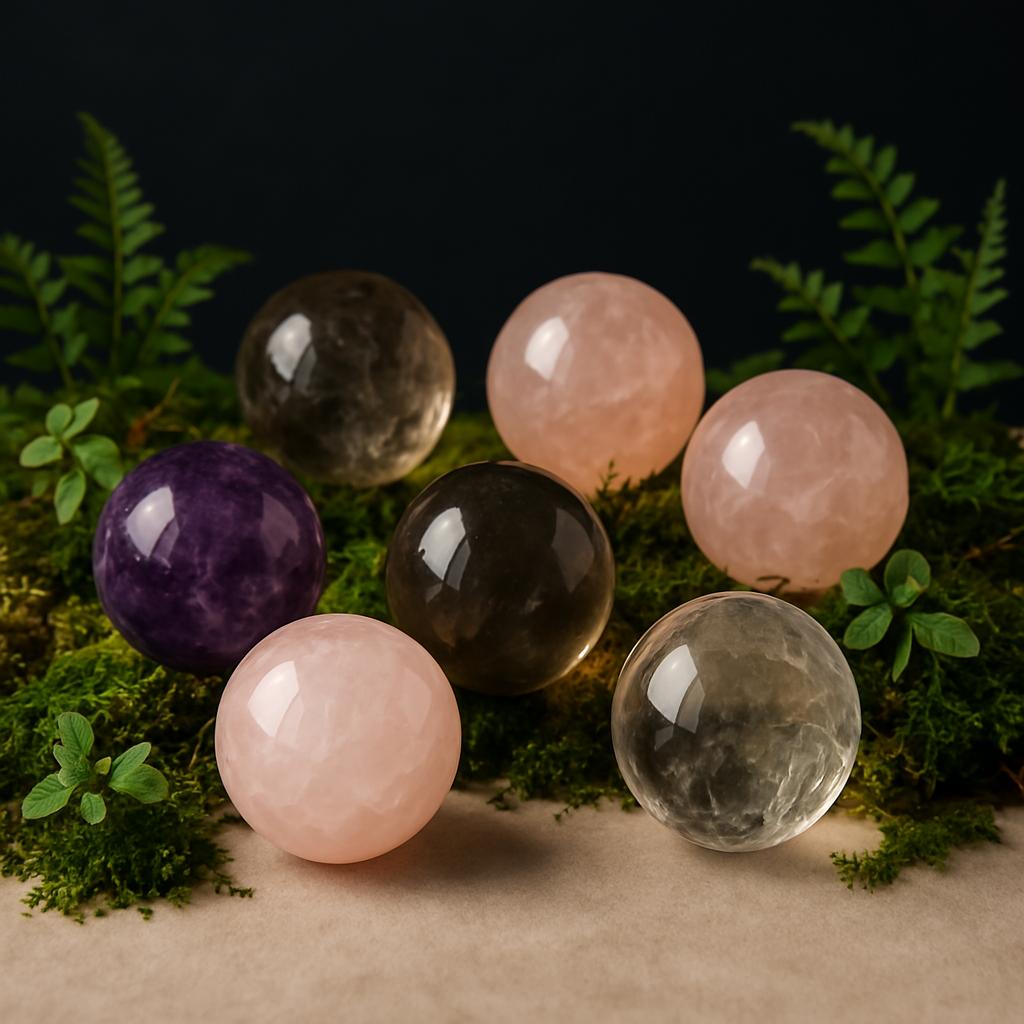
Round, smooth, and beautifully polished, crystal spheres have a way of catching the eye from every angle. Some reveal colorful bands, some contain fascinating inclusions, and others are so clear that looking through them feels a little like peering into another world.
But why are spheres so popular in the crystal world? How are they made, what makes them behave like tiny optical wonders, and where did the famous crystal ball get its mysterious reputation? Let's roll into the story!
Why do we love the sphere shape?
A sphere is a three-dimensional shape in which every point on its surface is approximately the same distance from its center. Unlike a tower, point, or polished freeform, a sphere has no corners, edges, or natural terminations.
That simple geometry creates an interesting display experience. You can turn a sphere in your hands and discover different colors, patterns, inclusions, and reflections without ever changing its overall shape.
Spheres also make wonderful showcases for stones with interesting internal features. Banded agate, ocean jasper, fluorite, labradorite, and included quartz can reveal different details as the light and viewing angle change.
There is also a practical reason they are popular with collectors: a polished sphere allows the natural character of a stone to be appreciated from all sides.
How are crystal spheres made?
Nature creates quartz crystals, but it doesn't generally grow them as perfectly polished balls. That beautiful spherical shape is the result of human craftsmanship.
Stone artisans begin with suitable rough material, which is shaped through grinding and progressively finer abrasive polishing. Creating a well-balanced sphere requires patience, careful material selection, and considerable skill.
The process can be especially challenging when working with stones that contain fractures, cleavage planes, or areas of different hardness. Some materials are more forgiving than others, while softer or fragile stones require extra attention.
Each has its own characteristics and value as a decorative or collectible object.
A crystal ball with a history
The crystal ball has become one of the most recognizable symbols of fortune-telling. Picture a mysterious room, velvet curtains, dramatic lighting, and someone announcing that they see something in your future!
The historical practice of looking into reflective or translucent objects for visions is commonly called scrying or crystal gazing. Different cultures and historical periods used different objects and methods, including polished surfaces, mirrors, water, and transparent stones.
Carved rock crystal spheres have a much broader history than their association with fortune-telling. The Metropolitan Museum of Art, for example, documents a rock crystal sphere from Cambodia dating to approximately the 12th century and a Chinese rock crystal ball from the 19th century.
These historical objects demonstrate that beautifully carved spheres were valued as crafted objects in their own right, not simply as mystical accessories.
The surprising science inside a crystal sphere
Here's where things get particularly interesting!
A clear quartz sphere can act like a lens. Because of its curved surface, light passing through it bends, creating optical distortions. In fact, the Smithsonian's National Museum of Natural History displays an enormous quartz sphere measuring 12.9 inches across and weighing approximately 106.75 pounds.
Its spherical shape makes the surrounding room appear upside down!
That's a wonderful demonstration of how light behaves when passing through curved transparent materials. The sphere isn't predicting the future, but it can certainly give your eyes something unexpected to look at.
Natural inclusions, internal fractures, and variations in clarity can make the optical effects even more interesting. Some spheres contain tiny mineral features that appear to float inside the stone, creating miniature landscapes within a polished surface.
What do crystal spheres symbolize?
In modern metaphysical traditions, spheres are often associated with wholeness, unity, balance, and the continuous cycles of life. Their lack of corners or obvious beginning and ending makes them popular symbols of completeness and interconnectedness.
Different crystal varieties add their own traditional associations:
- Clear quartz: Often associated with clarity, focus, and amplification.
- Amethyst: Traditionally connected with intuition, spiritual reflection, and tranquility.
- Rose quartz: Commonly associated with love, compassion, and emotional warmth.
- Obsidian: Often linked with grounding, protection, and introspection.
- Labradorite: Frequently associated with transformation, creativity, and intuition.
These meanings come from spiritual and metaphysical traditions rather than established scientific evidence. Interpretations vary among individuals and cultures, and crystals should never be considered medical treatments.
Caring for your crystal sphere
A sphere may look sturdy, but its care depends on the mineral from which it was made. Quartz, with a Mohs hardness of 7, is generally more scratch-resistant than softer materials such as calcite or fluorite.
Use a soft cloth for routine dusting, and check the cleaning requirements of the specific mineral before using water or cleaning products. Avoid dropping spheres, especially those with internal fractures or natural cleavage. A padded display stand can help prevent rolling and accidental damage.
One extra tip for clear, transparent spheres: be mindful of direct sunlight. Their curved surfaces can concentrate light, so keep them away from places where focused sunlight could reach combustible materials.
Whether you collect them for their beauty, geological features, or traditional symbolism, crystal spheres offer a wonderful combination of natural material and human craftsmanship.
At Craven Crystals, we love exploring how something as simple as a change in shape can give a stone an entirely different personality. From sparkling spheres to intricate carvings and natural crystal formations, there is always another little geological wonder waiting to be discovered. And if your sphere happens to make the room look upside down, well, at least you know the science behind the magic!