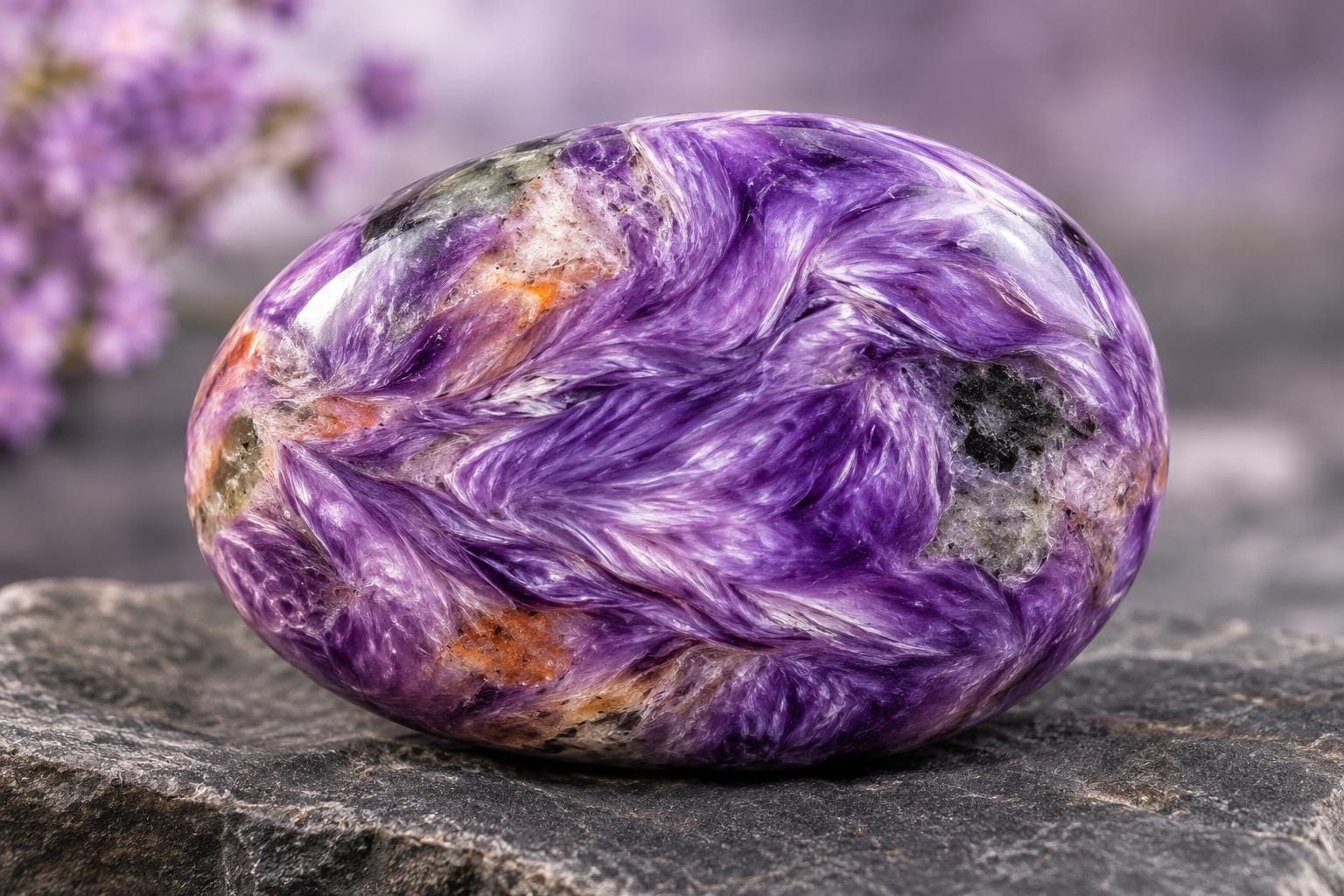
Some crystals sparkle, some glow, and some look as though an artist took a paintbrush to them. Charoite does something entirely different. Its flowing purple, lavender, white, and dark mineral patterns seem to swirl across the surface like ribbons of silk caught in a breeze. It is almost hypnotic, and the best part? Those patterns are entirely natural.
Known affectionately as one of Siberia's great mineral treasures, charoite has a story involving unusual geology, a remarkably limited source, and a discovery that introduced the world to a very distinctive shade of purple.
What exactly is charoite?
Charoite is a rare silicate mineral, but the material commonly used in jewelry and decorative carvings is technically a rock made up almost entirely of charoite, with other minerals mixed in. This is similar to how lapis lazuli is classified as a rock rather than a single-mineral specimen.
Its signature appearance comes from tiny, fibrous crystals arranged in complex, interlocking patterns. These fibers create the flowing swirls that make charoite so recognizable. Depending on the specimen, you may see shades ranging from pale lilac to deep violet, accompanied by white, gray, black, greenish, or orange-brown areas.
Some pieces also display a silky, shifting sheen called chatoyancy. As light moves across the surface, the fibers catch it at different angles, creating the impression that the stone is gently moving. No glitter required!
A geological treasure from Siberia
One of charoite's most remarkable features is its extremely limited natural occurrence. Gem-quality material is known from the Chara River area of the Murun Massif in the Sakha Republic of eastern Siberia, Russia.
The name charoite comes from the Chara River region. The material was first discovered in the 1940s, although it did not become widely known in Western gemstone markets until the 1970s.
Its formation is a fascinating example of contact metamorphism. This happens when hot intrusive rock comes into contact with surrounding rock, changing the minerals through heat and chemical interaction. In the Murun region, unusual combinations of intrusive rocks and limestone created the conditions that allowed charoite-bearing material to develop.
The result is a geological combination that has not been found elsewhere as a comparable gem source. That's a rather exclusive address for a purple rock!
What are those other colors inside it?
Charoite often contains companion minerals that add depth and personality to its patterns. These natural variations are part of what makes individual specimens so interesting.
- Orange and golden-brown: May come from tinaksite, a distinct mineral that can occur as elongated crystals.
- Dark green to black: Can be associated with aegirine-augite.
- Pale greenish-gray: May include microcline, a feldspar mineral.
- White and light gray: Can occur as additional mineral components within the rock.
Together, these materials create the scenic, almost painted appearance that makes charoite so popular with collectors and lapidary artists. Some polished pieces even resemble miniature landscapes!
How can you recognize charoite?
The most recognizable feature is its flowing, fibrous purple pattern. Look for interlocking swirls, a silky appearance, and natural variations in color. Some pieces show a gentle cat's-eye-like shimmer when tilted under light.
Charoite is typically rated around 5 to 6 on the Mohs hardness scale, making it softer than quartz, which measures 7. It can be polished beautifully, but it deserves a little extra care in jewelry and everyday handling.
As with many colorful ornamental stones, other materials can be made to resemble its appearance. Gemological testing may be useful when a precise identification is important, particularly for unusually uniform or atypical material. The International Gem Society reports no known synthetic or lab-created charoite and no known enhancements, while the Gemological Institute of America has documented manufactured materials designed to imitate it.
Caring for your purple treasure
Because charoite is moderately soft and has fair to good cleavage, gentle handling is best. Store it separately from harder stones to reduce scratching, and avoid knocking it against hard surfaces.
For cleaning, use a soft brush or cloth with mild detergent and warm water, then rinse carefully and dry. Avoid steam cleaners, ultrasonic cleaners, and high heat, which can be unsuitable for this heat-sensitive material.
Charoite can be lovely in pendants, earrings, cabochons, and decorative carvings. Rings may need protective settings because they receive more bumps and surface contact during daily activities.
More than a pretty shade of purple
In modern crystal traditions, charoite is sometimes associated with transformation, insight, and inner strength. These are spiritual and metaphysical interpretations rather than scientifically established effects, and meanings vary among traditions and individuals.
Whether you enjoy those symbolic associations or simply appreciate its unusual geology, charoite offers plenty to admire. Its flowing patterns tell a story of rare geological conditions, while every polished piece reveals a slightly different arrangement of natural color and texture.
At Craven Crystals, we love stones that give us a reason to look twice, ask questions, and discover something new. Charoite certainly earns its place in that category. It may come from one small corner of Siberia, but its personality is anything but small!