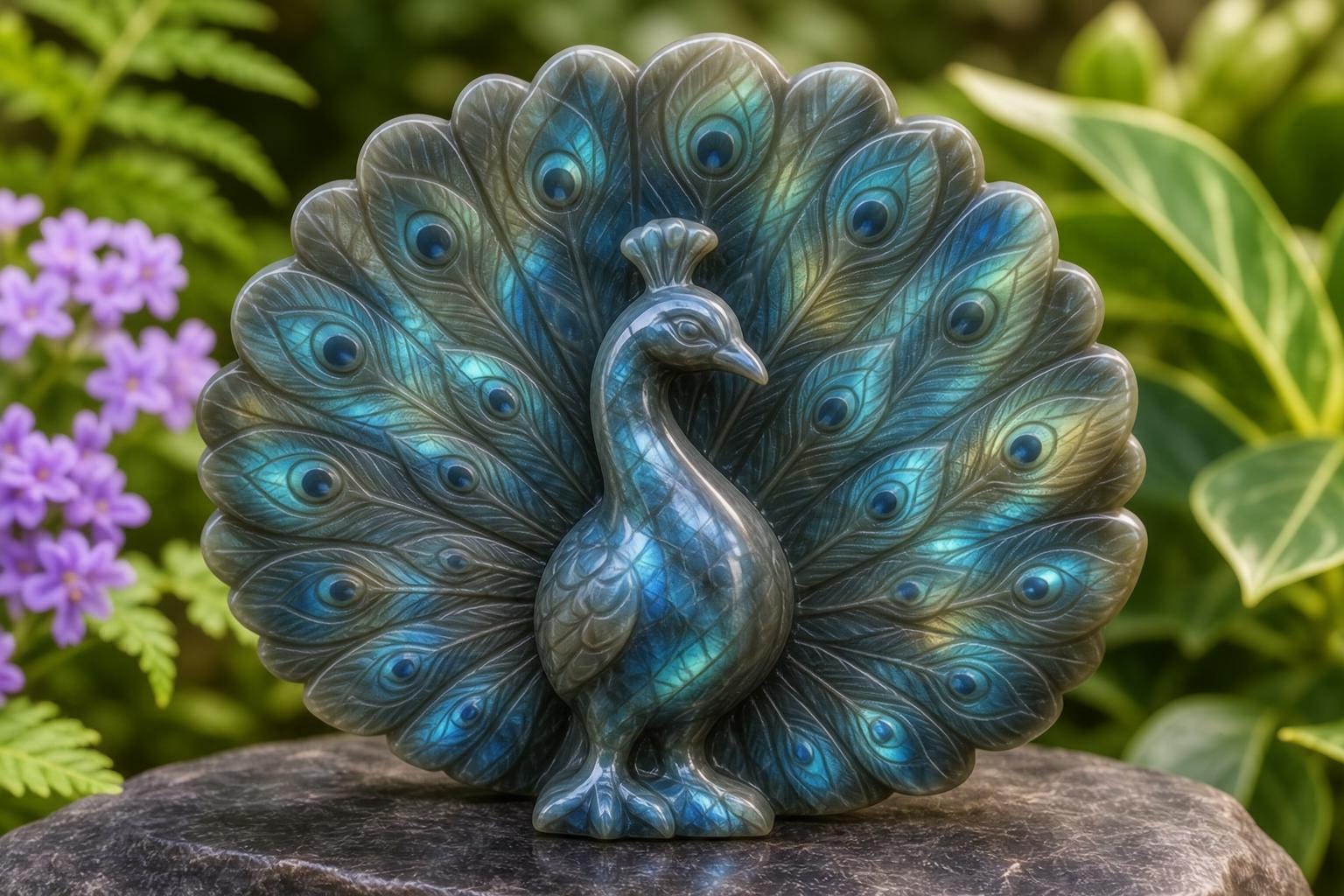
Few birds know how to make an entrance quite like the peacock. With a brilliant blue neck, graceful crest, and an extravagant fan of feather patterns, this feathered showstopper seems to have borrowed its wardrobe from a royal treasure chest. But those famous feather "eyes" are more than decoration. They have a fascinating scientific purpose, a rich cultural history, and a special place in the world of symbolic carvings.
First, is it a peacock or a peafowl?
Here's a fun little bird fact: peacock technically refers to the male, peahen refers to the female, and peafowl is the name for the group. The familiar Indian peafowl (Pavo cristatus) is native to India and Sri Lanka and is one of the most recognizable members of the pheasant family.
The male's spectacular display is created by elongated upper-tail coverts, which form a long train that fans out behind him. Those colorful, eye-shaped markings are called ocelli. During courtship, the male raises and spreads his train, displaying the patterns in an impressive visual performance. The actual tail feathers underneath help support the display.
And while the male gets much of the attention, peahens have their own understated beauty, with more muted plumage that helps them blend into their surroundings.
The science behind those shimmering feathers
One of the most remarkable things about peacock feathers is that their brilliant colors aren't produced by pigments alone. Much of their blue, green, and bronze shimmer comes from something called structural coloration.
Inside the tiny branches of a feather are microscopic structures containing melanin, keratin, and air spaces arranged in highly organized patterns. When light strikes these structures, it is reflected and interferes in ways that enhance particular colors. The result is an iridescent effect that can change with the viewing angle and lighting.
This is why a peacock feather may look deep blue from one direction and flash green or turquoise when it moves. Nature has essentially built a microscopic light show into every feather!
Scientists study this phenomenon as part of a broader field called biophotonics, which explores how living organisms interact with light. Researchers have even investigated how these natural structures might inspire new optical materials.
A bird with a legendary history
Peacocks have appeared in art, mythology, and decorative traditions across many centuries.
In Greek mythology, one familiar story connects the peacock's eyespots with Argus, a many-eyed watchman associated with the goddess Hera. After Argus died, Hera was said to have preserved his eyes in the peacock's feathers. It is a memorable explanation for those unmistakable feather patterns, although it belongs to mythology rather than natural history.
Peacocks also hold important places in South Asian religious art. In Hindu iconography, the deity Karttikeya, also known as Skanda or Murugan, is frequently depicted with a peacock as his mount. Historical sculptures and paintings show how closely the bird became associated with this deity in particular artistic and devotional traditions.
In early Christian art, the peacock sometimes represented immortality and the promise of eternal life. Its magnificent plumage and distinctive eyespots also inspired interpretations involving divine watchfulness. These meanings were not universal, but they demonstrate how one bird could inspire different symbolic stories in different communities.
What does a peacock carving symbolize?
Today, peacock carvings are often appreciated for their associations with beauty, confidence, renewal, and individuality. These are modern symbolic interpretations rather than fixed meanings shared by every culture.
- Beauty and self-expression: The peacock's elaborate display makes it a natural emblem of creativity, individuality, and celebrating what makes something unique.
- Confidence and dignity: Its upright posture and impressive plumage are often associated with self-assurance, presence, and personal pride.
- Renewal and new beginnings: The bird's changing feathers and dramatic seasonal appearance can inspire symbolism connected with growth and fresh chapters.
- Awareness and watchfulness: Those many eyespots have inspired associations with observation, attentiveness, and seeing the bigger picture.
For people who enjoy metaphysical traditions, these associations may carry personal meaning, but interpretations vary from person to person and are not scientifically established effects.
Why peacock carvings make memorable keepsakes
A peacock is a particularly expressive subject for a stone carving. Its sweeping tail offers room for intricate details, layered patterns, and beautiful color contrasts. Depending on the stone, natural veining, translucency, shimmer, or contrasting mineral bands can add an entirely different personality to the finished piece.
Some collectors are drawn to the bird's symbolism, while others simply appreciate the artistry and the challenge of capturing such an elaborate shape in stone. Either way, a peacock carving brings a little natural drama to a collection without needing to make a sound!
At Craven Crystals, we love exploring the stories behind the shapes and the natural materials that bring them to life. Whether your favorite part is the science of those shimmering feathers, the history behind the symbolism, or the beauty of a carefully carved stone, the peacock offers plenty to admire. After all, some natural wonders don't need a spotlight. They bring their own!