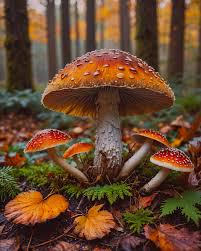
There is something wonderfully curious about mushrooms. One day the forest floor looks perfectly ordinary, and the next, little caps and stems have appeared as if someone held a secret woodland tea party overnight. Some are delicate, some are dramatic, and a few look as though they wandered straight out of a fairy tale.
Mushrooms have inspired folklore, art, stories, and decorative designs for generations. But beneath their whimsical appearance is a fascinating natural world that makes mushroom-shaped carvings especially meaningful for anyone who loves nature, imagination, and the mysteries hiding just beneath our feet.
More than a pretty little cap
First, a bit of mushroom science! Mushrooms belong to the kingdom Fungi, not the plant kingdom. The familiar cap and stem we recognize as a mushroom are actually the fruiting body of a much larger organism. Their job is to help produce and release spores, which can grow into new fungi under suitable conditions.
Much of the organism lives out of sight as a network of microscopic threads called hyphae. Together, these threads form a structure known as mycelium, which spreads through soil, wood, and other organic material.
Many fungi are nature's recyclers. They break down dead leaves, fallen branches, and other organic matter, returning nutrients to the environment. Others form beneficial partnerships with plant roots, helping plants access water and nutrients while receiving sugars in return.
So that little mushroom popping up beside a tree may be connected to a much larger story happening underground. The visible part is only the beginning!
Fairy rings and the magic beneath the grass
Few natural mushroom formations have inspired as much folklore as fairy rings. These are circular or crescent-shaped arrangements of mushrooms that sometimes appear in lawns, meadows, and woodland areas.
For centuries, people have connected these unusual circles with fairies, elves, witches, and supernatural dancing parties. European folklore includes stories of fairies gathering to dance beneath the moon, leaving circular marks behind. Some traditions warned people not to enter the rings, while others imagined them as gathering places between the human and fairy worlds.
The scientific explanation is just as fascinating. Fairy rings often develop as fungal mycelium grows outward through the soil. Under suitable conditions, mushrooms emerge around the actively growing outer edge, creating the familiar circular pattern. Some rings can expand over many years, becoming surprisingly large.
The fairies may not be responsible, but the fungi certainly know how to make an entrance!
What does a mushroom symbolize?
Mushroom symbolism is not tied to one universal ancient tradition. Meanings vary across cultures, stories, and modern decorative and metaphysical interpretations. Today, mushroom imagery often represents several appealing ideas.
- Growth and renewal: Mushrooms remind us that new life can emerge from places that appear quiet or forgotten. Their role in decomposition and nutrient recycling makes them natural symbols of life's continuing cycles.
- Mystery and imagination: With their unusual shapes, sudden appearances, and association with fairy rings, mushrooms have become familiar companions in fantasy art and enchanted woodland scenes.
- Connection and community: The underground mycelium network offers a lovely modern symbol of interconnectedness. Much of nature's activity happens out of sight, yet it supports the larger ecosystem.
- Adaptability and resilience: Fungi thrive in an extraordinary range of environments. Their ability to break down organic material and participate in different ecological relationships makes them a fitting emblem of adaptation and transformation.
These are symbolic interpretations rather than scientific or guaranteed metaphysical properties. Their meaning is personal, and part of the fun is deciding which qualities speak to you.
The famous red-and-white toadstool
One mushroom deserves a special mention: Amanita muscaria, commonly called the fly agaric. Its bright red cap, scattered white spots, and distinctive appearance have made it one of the most recognizable mushrooms in popular culture.
It appears frequently in fairy illustrations, woodland decorations, children's stories, and fantasy artwork. Its association with gnomes and fairies has helped make the red-and-white toadstool almost shorthand for an enchanted forest.
Despite its cheerful storybook appearance, this is a toxic mushroom and should never be treated as an edible novelty. Its decorative reputation is best enjoyed through art, illustration, and carving rather than a woodland snack!
Why mushroom carvings make such charming keepsakes
A mushroom carving can be playful without being childish, whimsical without losing its connection to nature, and meaningful without needing a complicated explanation. Its shape can remind someone of a favorite woodland walk, a beloved fairy tale, the beauty of autumn, or simply the joy of finding something unexpected.
For crystal enthusiasts, the mushroom form also creates an interesting meeting of two natural worlds: the mineral kingdom and the fungal kingdom. One develops through geological processes, while the other participates in living ecosystems. Both offer endless opportunities to appreciate the variety and creativity found in nature.
Whether you see a mushroom as a symbol of renewal, a little nod to fairyland, or a reminder that fascinating things are happening beneath the surface, its appeal is easy to understand.
At Craven Crystals, we love the stories behind the shapes, not just the sparkle of the stones. From woodland-inspired designs to the many curious forms found in nature, every carving can offer a little inspiration and a new reason to appreciate the world around us. Sometimes, the smallest things really do have the biggest stories!